
Multi-system trauma patients arrive with overlapping injuries that challenge even the most experienced nurses. A single patient may have a traumatic brain injury, hemorrhagic shock, and thoracic trauma all at once, and each condition complicates the management of the others.
Nurses who treat these patients need more than general clinical experience; they need specialized, structured preparation. TNCC prepares nurses for multi-system trauma care through a curriculum designed for patients whose injuries span multiple body systems at once.
A Systematic Framework for Chaos
Multi-system trauma creates clinical chaos because no two patients present the same way. TNCC addresses this by teaching nurses the Trauma Nursing Process, a structured assessment framework that guides care from the moment a patient arrives.
The primary survey directs nurses to evaluate airway patency, ventilation, circulation, and hemorrhage control before anything else, keeping life-threatening priorities front and center in a fast-paced, loud environment. The secondary survey follows with a detailed head-to-toe assessment designed to identify injuries that may not be present during the initial evaluation.
The value of this framework becomes clear in multi-system cases where one injury can mask another. A nurse focused solely on an obvious femur fracture may miss the early signs of intra-abdominal bleeding developing in the background.
TNCC trains nurses to move through the assessment sequence deliberately and repeat it as the patient’s condition evolves, which lowers the risk of a missed diagnosis when the stakes are highest. This repeated, structured approach ensures that subtle changes in a trauma patient’s condition are recognized early. As a result, nurses can intervene promptly and prevent minor issues from escalating into life-threatening complications.
Understanding How Injuries Interact

TNCC prepares nurses to think beyond individual injuries and recognize how damage across multiple body systems produces compounding physiological effects. A patient with both a traumatic brain injury and hemorrhagic shock present a particularly dangerous combination because the hypotension caused by blood loss directly worsens outcomes for an injured brain.
Nurses who understand this interaction know why maintaining cerebral perfusion pressure becomes a priority even when massive bleeding demands simultaneous attention. This advanced understanding allows nurses to anticipate complications and adjust interventions on the fly to improve patient outcomes.
The course covers injury patterns across the head, spine, thorax, abdomen, and musculoskeletal system with enough clinical depth to help nurses anticipate deterioration rather than simply react to it. TNCC teaches nurses to recognize how a tension pneumothorax can masquerade as cardiac tamponade, and why distinguishing between them quickly matters in a patient who cannot tolerate mismanagement of either.
This knowledge of injury-interaction gives nurses the clinical reasoning foundation that multi-system trauma care demands. It empowers them to make more informed decisions in rapidly changing and unpredictable clinical environments.
Psychomotor Skills Built for Trauma
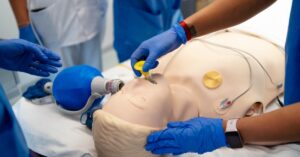
TNCC turns knowledge into hands-on competency through skills stations that target procedures nurses encounter in real-life trauma resuscitations. Nurses practice spinal motion restriction, chest decompression techniques, hemorrhage control, and airway management under direct instructor supervision. Instructors provide immediate corrective feedback at each station, helping nurses build precise technique before they use these skills on a real person.
These stations are essential for multi-system trauma care because nurses rarely perform a single intervention in isolation. A patient in traumatic arrest may require simultaneous airway management and hemorrhage control, and the nurse managing that patient must execute both with speed and accuracy.
TNCC’s skills stations build muscle memory and procedural aptitude, allowing nurses to perform under that kind of pressure in a simulated environment. This hands-on practice helps ensure that critical interventions become second nature when seconds matter most.
Simulation That Mirrors Real Trauma Presentations
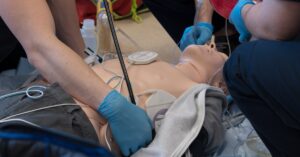
TNCC uses high-fidelity simulation scenarios to put nurses inside multi-system trauma cases before they encounter them in real life. These scenarios involve patients with layered, evolving injuries that require nurses to assess, prioritize, intervene, and reassess in rapid succession.
A scenario may begin with a hypotensive patient and escalate to reveal concurrent thoracic and abdominal injuries that demand a shift in clinical strategy mid-resuscitation. These dynamic scenarios mirror the unpredictability of real trauma cases and help nurses adapt to rapidly changing priorities.
Working through trauma courses for nurses in a simulated environment helps build the decision-making speed required for multi-system cases. Nurses learn to recalibrate their priorities when a patient’s status changes, rather than locking into a single treatment path that no longer fits the clinical picture.
Repeated simulation exposure also builds the psychological composure that allows nurses to think clearly when a real trauma room becomes pressure-packed, and the patient has competing demands. This mental readiness is crucial for effective decision-making and prioritization during high-stress trauma situations.
Communication and Team Performance Under Pressure

Multi-system trauma care is never a solo effort, and TNCC prepares nurses to function as sharp, communicative members of a trauma team. The course helps nurses build the clinical vocabulary and situational awareness they need to relay assessment findings quickly and accurately to physicians, surgeons, and other specialists.
When a nurse can communicate that a patient has developed signs consistent with a tension pneumothorax and a declining GCS, the team can mobilize the appropriate response without delay. Clear, timely communication in these moments can make the difference between rapid recovery and a preventable setback.
TNCC also addresses closed-loop communication, preventing critical information from being lost during high-volume resuscitations. Nurses practice confirming verbal orders and reporting back on completed interventions to ensure nothing falls through the cracks during a complex multi-system case.
This communication discipline enhances the trauma team’s overall performance and reduces error rates when patients are at their most vulnerable. It also fosters trust and cohesiveness among team members, which is essential for seamless collaboration during critical moments.
Trauma nursing is as complex and unpredictable as the patients who come through the doors. That’s why preparation should never be generic and must match the real-world challenges that nurses face in the trauma bay every day.
TNCC Certification: The Standard for Trauma-Ready Nurses
TNCC prepares nurses for multi-system trauma care by providing more than just textbook knowledge; it offers hands-on experience, practical skills, and a framework for making quick, confident decisions under pressure. Through realistic simulations and focused training, nurses gain the confidence and expertise needed to handle even the most chaotic cases.
At CPR123, we connect healthcare professionals across New York and Texas with AHA certification programs that build strong clinical foundations. We encourage trauma nurses to pursue every credential that sharpens their ability to save lives and elevates the care they provide.